
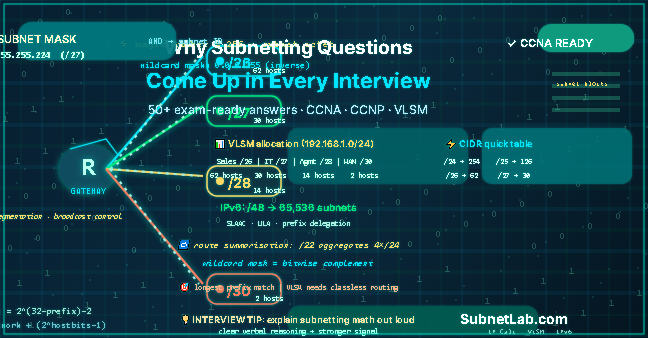
Why Subnetting Questions Come Up in Every Networking Interview
If you are preparing for a network engineer, CCNA candidate, or sys admin role, subnetting will almost definitely appear in your interview. It sits at the heart of how modern networks are designed, scaled, and secured.
Subnetting is not just a maths trick. It is the practical skill that lets engineers control broadcast domains, implement network segmentation, and plan IP address space professionally. Interviewers use it to test whether you can think logically under pressure.
This guide covers 50 subnetting interview questions with clear, exam-ready answers from beginner level through to CCNP-tier topics like VLSM, route summarisation, and IPv6 prefix delegation. Use the section links to jump straight to your weak spots.
Quick Tip — How to Use This Article
- Skim the full list first to find gaps in your knowledge.
- Re-read any section where you couldn’t answer within 30 seconds.
- Use the SubnetLab IP Subnet Calculator to verify any maths you are unsure about.
- Practice explaining answers out loud — interviewers reward clear verbal reasoning.
What This Guide Covers
| # | Section | Difficulty |
| 1 | Core Concepts & Definitions (Q1–Q10) | Beginner |
| 2 | Subnet Mask & CIDR Notation (Q11–Q20) | Beginner–Intermediate |
| 3 | Subnetting Calculations & VLSM (Q21–Q30) | Intermediate |
| 4 | Network Design & Routing (Q31–Q38) | Intermediate–Advanced |
| 5 | IPv6 Subnetting (Q39–Q44) | Advanced |
| 6 | Wildcard Masks & ACLs (Q45–Q47) | Advanced |
| 7 | Scenario-Based & Personal Questions (Q48–Q50) | Mixed |
Section 1: Core Concepts & Definitions
These questions test whether you have a solid mental model of IP addressing fundamentals. Expect them in the first five minutes of a phone screen.
Q1: What is subnetting and why is it used?
Subnetting is the process of dividing a larger IP network into smaller logical sub-networks called subnets.
It is used to reduce broadcast traffic, improve security through network segmentation, make more efficient use of IP address space, and simplify network management.
Tip: Always mention at least three reasons. Interviewers look for breadth.
Q2: What is the difference between a network address and a host address?
A network address identifies the subnet itself all host bits are set to 0. A host address identifies an individual device within that subnet.
For example, in 192.168.1.0/24, the network address is 192.168.1.0 and valid host addresses range from 192.168.1.1 to 192.168.1.254.
Q3: What is a subnet mask and how does it work?
A subnet mask is a 32-bit number that identifies which portion of an IP address is the network part and which is the host part.
It works by performing a bitwise AND operation between the IP address and the mask.
Tip: Know the binary AND operation — you may be asked to demonstrate it on a whiteboard.
Q4: What is the default subnet mask for Class A, B, and C networks?
Class A: 255.0.0.0 (/8) first octet 1–126.
——- B: 255.255.0.0 (/16) first octet 128- 191.
——- C: 255.255.255.0 (/24) — first octet 192–223. Classful addressing is largely obsolete with CIDR.
Classful addressing Reference
| Class | Range (First Octet) | Default Mask | CIDR | Default Hosts |
| A | 1 – 126 | 255.0.0.0 | /8 | 16,777,214 |
| B | 128 – 191 | 255.255.0.0 | /16 | 65,534 |
| C | 192 – 223 | 255.255.255.0 | /24 | 254 |
| D | 224 – 239 | N/A — Multicast | — | — |
| E | 240 – 255 | N/A — Reserved | — | — |
Q5: What is CIDR notation?
CIDR notation expresses an IP address and its subnet mask together using a slash followed by the prefix length the number of bits set to 1 in the mask. For example, 192.168.10.0/26 means the first 26 bits are the network portion, leaving 6 bits for hosts (64 addresses, 62 usable).
Tip: CIDR replaced classful addressing in 1993 to slow IPv4 exhaustion.
Q6: What are the two reserved addresses in every subnet?
Every subnet reserves its first address as the network address (all host bits = 0) and its last address as the broadcast address (all host bits = 1). These cannot be assigned to hosts.
Q7: What is a broadcast address and its purpose?
A broadcast address is the last IP address in a subnet. A packet sent to it is delivered to every host in that subnet simultaneously. Routers do not forward broadcast packets by default.
Q8: What is the loopback address and why does it matter?
The loopback address is 127.0.0.1 (range 127.0.0.0/8). It refers to the local device itself.
It is used to test TCP/IP stack functionality, run local services, and verify networking software. IPv6 loopback is ::1.
Q9: What are private IP address ranges?
RFC 1918 defines three private ranges: 10.0.0.0/8, 172.16.0.0/12, and 192.168.0.0/16.
These are not routed on the public internet and are used inside organization, with NAT translating them to public IPs.
Q10: What is the difference between a LAN and a subnet?
A LAN refers to the physical topology. A subnet is a logical division of an IP address space. A single LAN can have multiple subnets, and multiple LANs can share one subnet, but they describe different layers.
Section 2: Subnet Mask & CIDR Notation
Q11: How many usable host addresses does a /27 subnet provide?
A /27 mask leaves 5 host bits. Total addresses = 32. Usable hosts = 30. Subnet increment is 32.
Memorise the power-of-2 table from /24 to /30 — these come up constantly.
CIDR Quick-Reference Table
| CIDR | Subnet Mask | Total IPs | Usable Hosts | Subnet Increment |
| /24 | 255.255.255.0 | 256 | 254 | 256 |
| /25 | 255.255.255.128 | 128 | 126 | 128 |
| /26 | 255.255.255.192 | 64 | 62 | 64 |
| /27 | 255.255.255.224 | 32 | 30 | 32 |
| /28 | 255.255.255.240 | 16 | 14 | 16 |
| /29 | 255.255.255.248 | 8 | 6 | 8 |
| /30 | 255.255.255.252 | 4 | 2 | 4 |
| /31 | 255.255.255.254 | 2 | 2 (point-to-point) | 2 |
| /32 | 255.255.255.255 | 1 | 1 (host route) | — |
Q12: What is the subnet mask for /22?
A /22 mask has 22 ones. Calculation: 256 − 4 = 252 for the third octet. So the mask is 255.255.252.0. A /22 block contains 4 × /24 networks = 1,024 addresses.
Q13: How do you convert a subnet mask to CIDR prefix length?
Convert each octet to binary and count total 1 bits. For 255.255.240.0 → 11111111.11111111.11110000.00000000 = /20.
Practice both directions — mask → CIDR and CIDR → mask.
Q14: What subnet does the IP 192.168.50.130/26 belong to?
/26 mask 255.255.255.192, increment 64. 130 falls in .128 subnet → 192.168.50.128/26. Broadcast: 192.168.50.191.
Q15: What is the magic number method for subnetting?
Magic number = 256 − interesting octet of subnet mask. For 255.255.255.224, magic = 32. Subnets fall on multiples of 32.
Q16: What does /31 mean and when is it used?
/31 subnet has 2 addresses with no network/broadcast reservation (RFC 3021). Used for point-to-point links between routers.
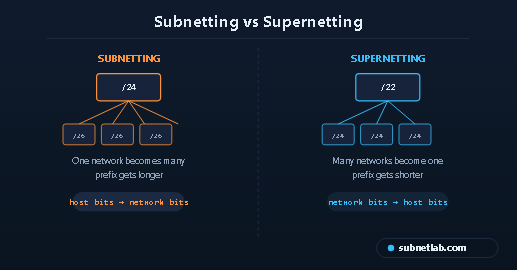
Q17: What is a supernet and how does it differ from a subnet?
Supernetting combines multiple smaller networks into a larger block by moving the prefix boundary left.
Reduces routing table size.
Q18: How many subnets does borrowing 4 bits from a /24 create?
2⁴ = 16 subnets, each a /28 with 16 addresses.
Q19: What is the difference between a host mask and a subnet mask?
A host mask (wildcard mask) is the bitwise inverse.
For 255.255.255.0, wildcard = 0.0.0.255.
Q20: Why can two hosts on the same physical switch still be on different subnets?
Physical connectivity and logical IP addressing are independent. A Layer 3 device (router) must forward packets between them.
Section 3: Subnetting Calculations & VLSM
Q21: Walk me through subnetting 10.0.0.0/8 into /24s. How many subnets?
Borrow 16 bits → 2¹⁶ = 65,536 subnets. Each /24 has 254 usable hosts.
Q22: What is VLSM and why is it important?
Variable Length Subnet Masking allows different subnets within the same major network to have different prefix lengths for efficient IP allocation. Requires classless routing protocol (OSPF, EIGRP, BGP).
Q23: Design a VLSM scheme for: Sales (50 hosts), IT (30 hosts), management (10 hosts), WAN links (2 hosts each, 3 links).
From 192.168.1.0/24: Sales /26 (62 hosts) → .0/26; IT /27 → .64/27; Management /28 → .96/28; WAN1 /30 → .112/30; WAN2 → .116/30; WAN3 → .120/30.
Always start with the largest subnet and work downward to avoid overlap.
VLSM Allocation Table — 192.168.1.0/24
| Subnet | Prefix | Network Address | Broadcast | Usable Hosts |
| Sales | /26 | 192.168.1.0 | 192.168.1.63 | 192.168.1.1 – .62 |
| IT | /27 | 192.168.1.64 | 192.168.1.95 | 192.168.1.65 – .94 |
| Management | /28 | 192.168.1.96 | 192.168.1.111 | 192.168.1.97 – .110 |
| WAN Link 1 | /30 | 192.168.1.112 | 192.168.1.115 | 192.168.1.113 – .114 |
| WAN Link 2 | /30 | 192.168.1.116 | 192.168.1.119 | 192.168.1.117 – .118 |
| WAN Link 3 | /30 | 192.168.1.120 | 192.168.1.123 | 192.168.1.121 – .122 |
Q24: What is the formula for the number of usable hosts in a subnet?
Usable hosts = 2^(host bits) − 2. Host bits = 32 − prefix length.
Q25: If a router interface is 172.16.5.1/20, what is the valid host range?
Mask 255.255.240.0, magic number 16. Network 172.16.0.0, broadcast 172.16.15.255, valid hosts 172.16.0.1 – 172.16.15.254.
Q26: How do you find the subnet ID of any IP address?
Perform a bitwise AND between the IP address and the subnet mask. Example: 10.20.35.200 AND 255.255.248.0 = 10.20.32.0.
Q27: What is route summarisation?
Route summarisation combines multiple contiguous routes into a single summary route to reduce routing table size. Example: 192.168.4.0/24–7.0/24 summarises to 192.168.4.0/22.
Q28: How many /26 subnets fit inside a /22?
Difference = 4 bits → 2⁴ = 16 subnets.
Q29: What is the broadcast address of 172.20.100.64/27?
/27 mask 255.255.255.224, magic 32. Network .64, next boundary .96 → broadcast .95.
Q30: A company needs 500 subnets, each with at least 50 hosts. What prefix?
Host bits ≥6 → /26 minimum. Subnet bits ≥9 → from /8: 8+9+6 = /23 works? Actually /26 provides 62 hosts and 2^9=512 subnets from a /17 base. Final answer: use a /23 or /22 scheme, but standard: borrow subnet bits accordingly.
Section 4: Network Design & Routing
Q31: Difference between routed protocol and routing protocol?
Routed protocol (IP) carries user data. Routing protocol (OSPF, BGP) exchanges routing info.
Q32: Does OSPF support VLSM? What about RIPv1?
OSPF supports VLSM; RIPv1 does not (classful).
Q33: What is a default route?
0.0.0.0/0 matches any destination not found in routing table. Gateway of last resort.
Q34: What is the longest prefix match rule?
Router selects the route with the most specific (longest) prefix length when multiple routes match.
Q35: What is NAT and relation to subnetting?
NAT translates private IPs (RFC1918 subnets) to public IPs, allowing private subnets to access internet.
Q36: How does inter-VLAN routing work with subnetting?
Each VLAN maps to a unique subnet. Layer 3 switch provides gateway per subnet, routing between VLANs.
Q37: What causes subnet overlap error?
Two subnets covering same IP range. Prevent via VLSM planning and IPAM tools.
Q38: What is a DMZ subnet and sizing?
DMZ houses public-facing servers. Typically /28 (14 hosts) or /27 (30 hosts).
Section 5: IPv6 Subnetting
Q39: Structure of an IPv6 address?
128 bits, 8 groups of 4 hex digits. Leading zeros omitted, :: for one run of zero groups.
| IPv6 Component | Bits | Notes |
| Global Routing Prefix | 48 | Assigned by RIR/ISP |
| Subnet ID | 16 | Organisation controls |
| Interface ID | 64 | Host portion |
Q40: Standard IPv6 prefix assigned to end sites?
/48 allocation → 65,536 subnets (each /64).
Q41: What is SLAAC?
Stateless Address Auto configuration: router advertises /64 prefix, host builds interface ID to form address.
Q42: What are link-local addresses in IPv6?
FE80::/10, automatically configured, valid only on local link, not routed.
Q43: How many /64 subnets does a /48 provide?
2¹⁶ = 65,536 subnets.
Q44: IPv6 equivalent of RFC 1918 private addresses?
Unique Local Addresses (ULA) FC00::/7, commonly FD00::/8.
Section 6: Wildcard Masks & ACLs
Q45: What is a wildcard mask and how is it calculated?
Bitwise complement of subnet mask. Subtract mask from 255.255.255.255: for 255.255.255.240 → 0.0.0.15.
wildcard mask Reference
| Subnet Mask | Wildcard Mask | CIDR | Matches |
| 255.255.255.0 | 0.0.0.255 | /24 | All hosts in a /24 |
| 255.255.255.128 | 0.0.0.127 | /25 | Half of a /24 |
| 255.255.255.252 | 0.0.0.3 | /30 | 4-address point-to-point |
| 255.255.255.255 | 0.0.0.0 | /32 | Exact host match |
Q46: Write a Cisco ACL wildcard to permit only the 10.10.0.0/22 network.
Wildcard = 0.0.3.255. ACL: access-list 10 permit 10.10.0.0 0.0.3.255
Q47: Difference between standard and extended ACL?
Standard matches source IP; extended matches source, destination, protocol, ports.
Section 7: Scenario-Based & Personal Questions
Q48: Tell me about a time you redesigned a network’s IP scheme.
Use STAR method: discovering overlapping subnets after attainment, auditing with IPAM, designing VLSM, phased renumbering with DHCP changes.
Even lab experience counts — frame it clearly.
Q49: A user reports they cannot communicate with a server on a different subnet. Troubleshooting steps?
- Verify IP config 2
- Ping default gateway 3
- Ping server from gateway 4
- Check routing tables
- 5) Verify ACLs
- 6) Check ARP
- 7) Traceroute.
Q50: How do you stay current with networking technologies?
Follow RFCs, NANOG, practice on SubnetLab tools, GNS3, vendor blogs, and reference RFC1918, RFC4291, RFC3021.
Bonus: Subnetting Rapid-Fire Cheat Sheet
| Concept | Key Fact |
| Usable hosts formula | 2^(32 − prefix) − 2 |
| Number of subnets | 2^(bits borrowed) |
| Magic number | 256 − interesting subnet mask octet |
| Subnet ID of any IP | IP address AND subnet mask (binary) |
| Broadcast address | Network address + (2^host bits − 1) |
| VLSM requirement | Classless routing protocol (OSPF, EIGRP, BGP, RIPv2) |
| Wildcard mask | 255.255.255.255 − subnet mask |
| /31 use case | Point-to-point links only (RFC 3021) |
| IPv6 standard LAN prefix | /64 |
| Private ranges (RFC 1918) | 10/8, 172.16/12, 192.168/16 |
| Longest prefix match | Most specific route wins |
Practice Your Subnetting on SubnetLab Tools
The fastest way to lock in these concepts is hands-on practice. SubnetLab.com provides free tools:
- IP Subnet Calculator network, broadcast, host range, wildcard mask.
- Binary to Decimal Converter practice subnet mask conversion.
- VLSM Calculator automatic VLSM allocation.
- IPv6 Prefix Calculator explore /48 to /64 subnetting.
→ Open the SubnetLab Subnet Calculator | Try the VLSM Tool | IPv6 Validator
Author Profile
-
Muhammad Kazim Ali – Owner & Principal Engineer at SubnetLab.com (real-world networking labs).
10+ years in routing, switching & infrastructure design. Helps students, pros & enterprises master networking via practical labs. Based in Lahore, works with ISPs, data centers & tech teams.
📞 +92 343 5201037 (WhatsApp) | ✉️ subnetlab.official@gmail.com | 🌐 subnetlab.com
Latest entries
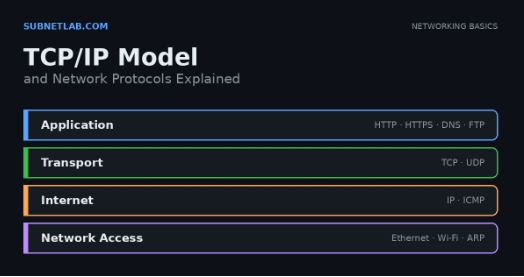 Network BlogAugust 25, 2026TCP/IP Model and Network Protocols Explained:TCP, UDP, ICMP, Handshakes, Flags, and Data Flow
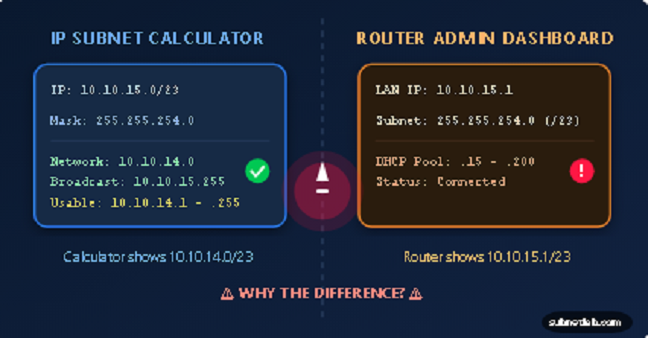 Network BlogAugust 11, 2026Router vs Calculator Showing Different Subnets? Why & the Fix
 Network BlogAugust 6, 2026Supernetting Explained: The Opposite of Subnetting
 Network BlogAugust 5, 2026Ping Command Explained:Your First Tool for Network Troubleshooting