
Your router’s routing table has 500 entries. Then someone summarizes them into one line, and traffic still finds its way perfectly.
That single line is called a supernet, and the process behind it is supernetting.
If subnetting is about breaking a big network into smaller pieces, supernetting is the reverse: taking many small networks and folding them back into one larger block. It sounds like a niche routing trick, but it quietly keeps the entire internet’s routing tables from collapsing under their own weight.
This guide explains what supernetting actually is, how the math works, and where you’ll run into it in real networks.
What Is Supernetting? Definition and Core Concept
Supernetting is the process of combining multiple contiguous, smaller network blocks into a single, larger network with a shorter prefix length. It’s also called route aggregation or route summarization, depending on the context.
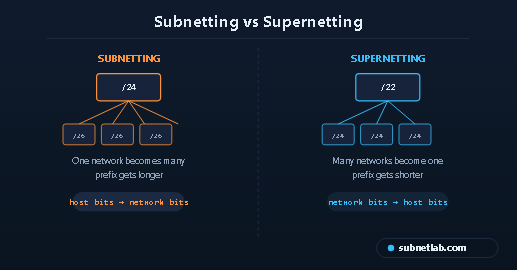
Where subnetting borrows bits from the host portion to create more, smaller networks, supernetting does the opposite. It gives bits back to the host portion, merging several small networks into one bigger one with fewer routing entries.
This only became possible with CIDR, Classless Inter-Domain Routing, introduced in RFC 1519. Before CIDR, networks were locked into rigid Class A, B, and C boundaries. CIDR broke that rule and let network prefixes end anywhere, which is exactly what makes supernetting mathematically possible.
Supernetting as Route Aggregation
In practice, supernetting shows up most often inside routing tables, not on end-user devices. A router doesn’t need to know about 16 separate /24 networks if they all sit behind the same next hop and happen to be contiguous. It just needs the one summarized route.
Why Supernetting Exists: The Routing Table Problem
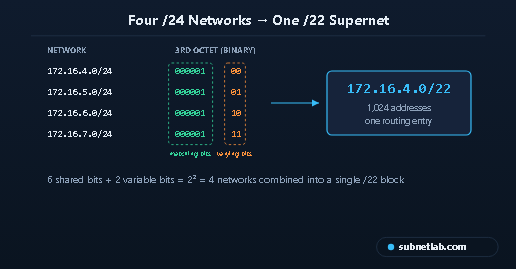
The global routing table exceeded 1 million entries in 2024, and it keeps growing. Every entry consumes memory on a router and adds a few microseconds to lookup time. Multiply that across every core router on the internet, and the cost becomes real.
Supernetting solves this by replacing many specific routes with one general route, as long as the underlying networks share a next-hop and sit next to each other numerically.
| Without Supernetting | With Supernetting |
|---|---|
| 192.168.0.0/24 | |
| 192.168.1.0/24 | |
| 192.168.2.0/24 | 192.168.0.0/22 |
| 192.168.3.0/24 |
Four routing entries collapse into one. The router still reaches every address in all four original networks; it just does so with a single lookup instead of four.
How Supernetting Works: Step-by-Step
Supernetting follows a predictable process, and it’s really just subnetting math run in reverse.
Step 1: Identify Contiguous Networks
The networks being combined must sit back-to-back in address space, with no gaps and no overlaps. 192.168.0.0/24 through 192.168.3.0/24 qualify. 192.168.0.0/24 and 192.168.5.0/24 do not, because they aren’t adjacent.
Step 2: Confirm the Block Size Is a Power of 2
You can only subnet counts of networks that are powers of two: 2, 4, 8, 16, and so on. Trying to summarize three /24 networks into one clean supernet doesn’t work, because 3 isn’t a power of 2. You’d either need to summarize 4 (and slightly over-include one extra network) or leave them as three separate routes.
Step 3: Find the Common Prefix Bits
Write the networks in binary and find where the bits stop matching. That point becomes your new, shorter prefix length.
Step 4: Verify Alignment on the Boundary
The starting address of the block must fall on a boundary that matches the new prefix. A /22 supernet must start on a multiple of 4 in the third octet (0, 4, 8, 12…), not just any four consecutive /24s.
Supernetting vs Subnetting: Key Differences
These two processes sit on opposite ends of the same CIDR math, and it’s easy to mix them up.
| Feature | Subnetting | Supernetting |
|---|---|---|
| Direction | Splits one network into many | Merges many networks into one |
| Prefix change | Gets longer (e.g., /24 to /26) | Gets shorter (e.g., /24 to /22) |
| Host bits | Borrowed, reducing hosts per subnet | Returned, increasing hosts per block |
| Typical use | Internal network segmentation | Route summarization, ISP aggregation |
| Who uses it | Network admins designing LANs | ISPs and core routers managing tables |
| Common tool | Subnet calculator | Route summarization / CIDR calculator |
A Worked Example
Suppose an ISP has assigned these four networks to a customer:
- 172.16.4.0/24
- 172.16.5.0/24
- 172.16.6.0/24
- 172.16.7.0/24
Converting the third octet to binary:
- 4 = 00000100
- 5 = 00000101
- 6 = 00000110
- 7 = 00000111
The first six bits (000001) are identical across all four. The remaining two bits vary, which is exactly what you’d expect from four networks, since 2² = 4.
That gives a new prefix of /22, and the summarized route becomes:
172.16.4.0/22
One entry now covers all 1,024 addresses across the original four /24 blocks.
Where Supernetting Shows Up in Real Networks
BGP Route Summarization
Internet Service Providers rely on supernetting constantly. Instead of announcing every individual customer subnet to the rest of the internet through BGP, an ISP aggregates them into one advertised block. This is a major reason global routing tables stay (relatively) manageable.
OSPF and EIGRP Area Boundaries
Inside enterprise networks, routers running OSPF or EIGRP summarize routes at area or autonomous system boundaries. A branch office with a dozen internal /24s might only advertise one /20 to the rest of the WAN, hiding internal complexity from routers that don’t need to see it.
VLSM’s Companion Process
If you’ve used Variable Length Subnet Masking (VLSM) to carve up an address space efficiently, supernetting is often the next step for whoever manages the network above yours. Your ISP or upstream provider may summarize your carefully planned subnets right back into one line for their own routing table.
Common Supernetting Mistakes
Assuming any group of networks can be summarized. If the block count isn’t a power of 2, or the networks aren’t properly aligned, a “clean” supernet doesn’t exist. You either summarize a larger, slightly wasteful block or leave the routes separate.
Ignoring discontiguous ranges. Skipping over a network in the middle of the range (because it belongs to someone else, for example) breaks the aggregation. You cannot supernet around a hole.
Confusing supernetting with private addressing. Supernetting is a routing and aggregation concept. It has nothing to do with whether the addresses involved are public or private under RFC 1918.
FAQs
Is supernetting the same as CIDR?
Not exactly. CIDR is the addressing system that removed strict class boundaries and made variable-length prefixes possible. Supernetting is one specific technique that CIDR enables.
Can I supernet on a home router?
Not usually. Supernetting matters at the routing table level, which home routers don’t manage in any meaningful way. It’s relevant to ISPs, enterprise routers, and anyone configuring route summarization on OSPF, EIGRP, or BGP.
What’s the largest possible supernet?
In theory, you could summarize all the way up to a /0, which represents the entire IPv4 address space. In practice, summarization stops wherever routing policy, ownership boundaries, or non-contiguous allocations get in the way.
Does supernetting reduce the number of usable host addresses?
No. The total number of usable addresses stays the same. Supernetting only changes how those addresses are represented and routed, not how many exist.
Conclusion
Supernetting is subnetting’s mirror image: instead of dividing address space to organize a network, it recombines address space to simplify how that network gets routed. It’s the quiet mechanism behind why the internet’s routing tables haven’t collapsed under a million-plus routes, and understanding it rounds out the other half of the CIDR math that subnetting only tells half of.
If you’re working through your own address planning, try running your VLSM allocations through SubnetLab’s subnet mask calculator, and check the VLSM Calculator to see how your subnetted ranges would look summarized back into a single block.
Author Profile

-
Muhammad Kazim Ali – Owner & Principal Engineer at SubnetLab.com (real-world networking labs).
10+ years in routing, switching & infrastructure design. Helps students, pros & enterprises master networking via practical labs. Based in Lahore, works with ISPs, data centers & tech teams.
📞 +92 343 5201037 (WhatsApp) | ✉️ subnetlab.official@gmail.com | 🌐 subnetlab.com
Latest entries
 Network BlogAugust 25, 2026TCP/IP Model and Network Protocols Explained:TCP, UDP, ICMP, Handshakes, Flags, and Data Flow
 Network BlogAugust 11, 2026Router vs Calculator Showing Different Subnets? Why & the Fix
 Network BlogAugust 6, 2026Supernetting Explained: The Opposite of Subnetting
 Network BlogAugust 5, 2026Ping Command Explained:Your First Tool for Network Troubleshooting