
Ipv4 vs IPv6 Subnetting: One of the hardest web concepts to really understand in computer networking. It’s the reason for how devices communicate, why networks scale and whether IP addresses are used smartly
As millions of devices join the network daily,phones, servers, IoT sensors, cloud computers, the right subnetting keeps networks running fast, safe and hassle-free.
But these days the world of networking doesn’t just depend on IPv4. With the expansion of the internet, IPv6 has become a requirement and this brings with it new subnetting.
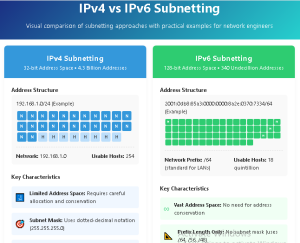
.
What Is Subnetting?
Subnetting means dividing a large network into smaller logical segment.
This division:
- Reduces broadcast traffic
- Increases network performance
- Improves security
- Makes IP management easier
- Helps organize large organizations into smaller network zones
Both IPv4 and IPv6 support subnetting, but they work differently due to their address size, structural design, and purpose.
IPv4 Subnetting The usual Method
IPv4 consists of 32-bit addresses, which gives roughly 4.3 billion IPs.
Due to limited space, subnetting in IPv4 is designed for:
- conserving IP addresses
- optimizing broadcast domains
- controlling network growth
- efficient address allocation
- VLSM (Variable Length Subnet Masking)
Key components of IPv4 subnetting
- Subnet Mask: Example → 255.255.255.0
- CIDR Notation: Example → /24
- Broadcast Address: Last address in the subnet
- Network Address: First address
- Usable Hosts: All addresses between network & broadcast
A typical subnetting task involves calculating:
- total number of hosts
- required networks
- subnet boundaries
- address ranges
Example: Subnetting IPv4
Network: 192.168.1.0/24
Divide into 4 subnets → /26
| Subnet | Network | Host Range | Broadcast |
| 1 | 192.168.1.0 | .1 – .62 | .63 |
| 2 | 192.168.1.64 | .65 – .126 | .127 |
| 3 | 192.168.1.128 | .129 – .190 | .191 |
| 4 | 192.168.1.192 | .193 – .254 | .255 |
This is classic IPv4 subnetting precise, careful, and resource-driven.
IPv6 Subnetting – A Completely Different move toward
IPv6 uses 128-bit addresses, giving 3.4×10³⁸ possible IPs so many that the entire earth could have trillions of IPs per person.
Because IPv6 has no shortage of IPs, subnetting is designed to be:
- simpler
- standardized
- hierarchical
- scalable for future networks
- optimized for routing
- free from broadcast traffic
IPv6 does NOT use subnet masks.
Instead, it uses prefix lengths, like:
- /64
- /56
- /48
Key differences from IPv4:
- No broadcast addresses
- Vast address space eliminates VLSM complexity
- Subnetting focuses on prefix planning, not address conservation
- Interface IDs are usually auto-generated (EUI-64 or random)
- Every LAN must use /64 for compatibility with SLAAC
Example IPv6 Network
2001:db8:1000::/48
This can be divided into many /64 subnets:
- 2001:db8:1000:0001::/64
- 2001:db8:1000:0002::/64
- 2001:db8:1000:0003::/64
…and so on.
Unlike IPv4, you don’t calculate “hosts.” Each IPV 6 / 64 subnet has 18 quintillion possible addresses, sufficient for any network.
IPv4 vs IPv6 Subnetting: The Key Differences
Here’s a clear comparison that highlights an important distinction:
1. Address Length
| Protocol | Bit Length | Total Addresses |
| IPv4 | 32-bit | 4.3 Billion |
| IPv6 | 128-bit | 340 undecillion |
IPv6’s huge space removes the need for address saving tricks.
2. Subnet Representation
| IPv4 | IPv6 |
| Subnet Mask & CIDR | Prefix Length Only |
| Example: 255.255.255.0 | Example: /64 |
3. Broadcast Support
| IPv4 | IPv6 |
| Has broadcast address | No broadcast address |
| Risk of broadcast Leaks | Uses multicast instead |
4. Host Calculation
| IPv4 | IPv6 |
| Usable hosts = 2^h − 2 | No host calculation needed |
| Limited hosts per subnet | Each subnet has a huge space |
5. Subnetting Purpose
| IPv4 | IPv6 |
| Address conservation | Network organization |
| Reducing broadcast domains | Hierarchical subnet design |
| VLSM used often | Standard /64 used for LAN |
Auto-Configuration
- DHCP is mostly used in IPv4.
- IPv6 supports DHCP VERSION 6, SLAAC, and stable address creation.
- How to Subnet IPv4: Simple Steps
If you want to subnet IPv4:
- Identify required hosts or subnets
- Find subnet mask or CIDR needed
- Calculate block size
- Determine network, broadcast, and usable host range
- Assign subnets to departments or VLANs
Example requirement: 30 hosts
→ /27 mask (32 IPs, 30 usable)
IPv4 requires careful planning to avoid wasting IPs.
-
How to Subnet IPv6: Simple Steps
IPv6 subnetting is easier and more standardized.
Step-by-Step IPv6 Subnetting Plan
(1) Start with your assigned prefix
Example: /48 from ISP or provider
(2) Decide internal subnets
Typically /64 for all LANs—recommended by every RFC.
(3) Increment the 4th block
Example:
- 2001:db8:abcd:0001::/64 → Office 1
- 2001:db8:abcd:0002::/64 → Office 2
- 2001:db8:abcd:0003::/64 → Datacenter
- 2001:db8:abcd:0004::/64 → Guest WiFi
(4) Document and assign names
Good IPv6 planning requires clear naming conventions.
(5) Configure routing
Routers use prefix-based routing, which is more efficient than IPv4 routing.
- Why IPv6 Subnetting Is Much Easier
IPv6 doesn’t require:
- calculating usable hosts
- checking broadcast addresses
- shrinking or expanding masks
- VLSM
- saving IPs
- converting subnet masks to binary
This makes IPv6 ideal for modern cloud networks, ISPs, and enterprise environments.
- Real-World Example: IPv4 and IPv6 Together (Dual-Stack)
Most organizations use dual-stack networking, meaning:
- IPv4 and IPv6 run at the same time
- Devices communicate using whichever protocol is preferred
- Both types of subnetting must be planned together
Example Dual-Stack Setup
| Department | IPv4 Subnet | IPv6 Subnet |
| HR | 192.168.10.0/26 | 2001:db8:1000:10::/64 |
| IT | 192.168.10.64/26 | 2001:db8:1000:20::/64 |
| Sales | 192.168.10.128/26 | 2001:db8:1000:30::/64 |
This setup ensures compatibility across all devices, routers, and applications.
-
Common Mistakes When Working With IPv4 and IPv6
IPv4 Mistakes
- Overlapping subnets
- Wrong subnet masks
- Ignoring future growth
- Misconfigured gateways
IPv6 Mistakes
- Using prefixes smaller than /64 for LANs
- Mixing uppercase and lowercase hexadecimal inconsistently
- Poor documentation of prefixes
- Forgetting to disable IPv6 privacy extensions when needed
Dual-Stack Mistakes
- Missing IPv6 firewall rules
- Using IPv4 NAT while ignoring IPv6 routing
- Not monitoring IPv6 traffic
- Forgetting DNS AAAA records
-
Conclusion:
As networking continues to grow, both protocols are in place.
- IPv4 subnetting basically controls broadcast domains and protects IP space.
- IPv6 subnetting is used for simplicity, scalability, and future-proof design.
If you are planning a modern network, you must understand both IPv4 for compatibility and IPv6 for long-term expansion.
Related Posts
What’s the best part?
Calculating everything by hand is not possible